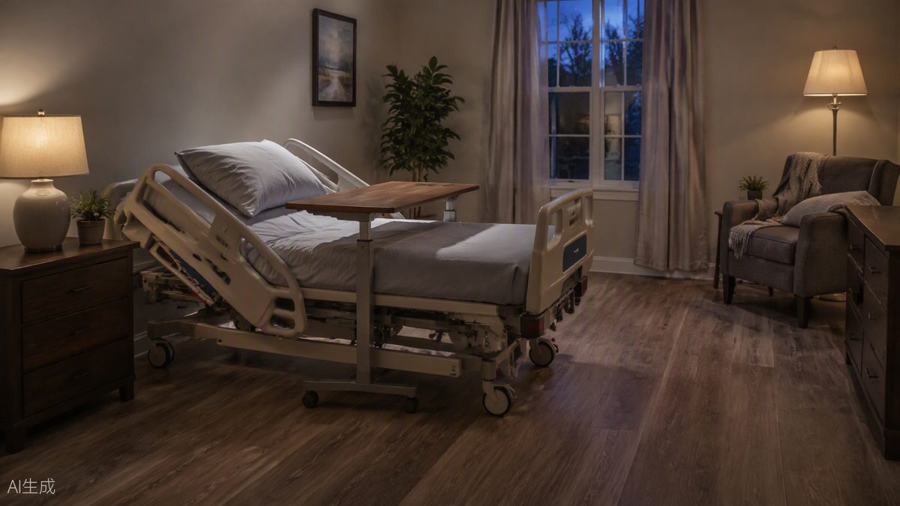
When a parent or partner can no longer leave their bed, families rarely receive training — they receive a discharge letter and a room that must become a care space within days. The short answer the reviewed guides converge on: work through five categories in order — the bed, the mattress, transfer aids, the everyday environment, and professional guidance — and agree the final setup with the treating physician, a nurse or a physiotherapist. This article is general information drawn from published home-care guides, not medical advice.
Start with the bed itself
A standard household bed forces caregivers into back-straining positions and makes repositioning far harder. As the English-language home-care essentials guide describes, an electric home-care bed addresses three fronts at once: height adjustment lets carers work without bending, a raised backrest supports eating and breathing comfort, and adjustable leg sections help with the circulation-friendly positioning professionals recommend. Side rails can reduce fall risk for restless patients — though, as the Hungarian-language versions of the guide caution, rails fitted incorrectly create entrapment risks, so their use is worth discussing with an occupational therapist or nurse. When choosing, the guides advise checking the safe working load, whether the motors are quiet enough for night-time adjustment, and how the bed can be cleaned.
Why does the mattress matter most?
Skin that bears body weight without interruption can break down into pressure ulcers — described in the Hungarian-language version of the home-care guide as one of the most serious and most preventable complications of long-term bed rest. Guidance from the European Pressure Ulcer Advisory Panel (EPUAP), cited in the reviewed pages, rests on two pillars: regular repositioning and appropriate support surfaces. Anti-decubitus mattresses come in two broad families. Static foam mattresses redistribute pressure through contoured or viscoelastic foam and suit lower-risk situations; alternating-air systems use a compressor that cyclically shifts pressure points and are typically considered for higher-risk patients. No mattress replaces repositioning — equipment supports care, it does not deliver it.
Transfers, walkthroughs and the everyday environment
Moving a person who cannot bear weight is where home caregivers most often injure themselves. The mirror edition of the bedroom-safety guide describes how patient lifts turn a hazardous manual manoeuvre into a controlled transfer between bed, wheelchair and commode, while simpler aids — transfer boards, grab handles, bed levers — help in partial-mobility cases.
Beyond the headline equipment, dozens of small decisions shape daily life. The further Hungarian edition of the guide lists the unglamorous essentials: an overbed table that brings meals and medication within reach, waterproof mattress protectors and washable bedding, good layered lighting, clear walking paths for the caregiver, and a call option — even a simple bell or baby monitor. Bathroom grab bars, bath seats and shower chairs matter from the first day the patient attempts any transfer out of bed, because falls most often happen in wet rooms.
A separate Hungarian article on safe home care and checking medical devices adds a process layer the equipment lists miss. Walk the route the relative actually moves — bed to chair, chair to door, door to bathroom — at the times they really move, and note every threshold, loose rug, trailing cable and awkward corner. Do it twice: once alone, once with the person living in the room, because two people notice different hazards. Rooms drift back toward clutter, so the same article recommends a weekly routine of about ten minutes: test the night lamps, clear the bathroom route, check the call bell. Write the routine down, laminate it near the bed, and assign a named person to each check when several relatives rotate through the week.
Sourcing equipment and setting expectations
Specialist webshops let families compare categories calmly rather than accepting whatever is nearest. The reviewed sourcing overview of home-care equipment in Hungary profiles one such specialist — a Piliscsaba-based retailer whose range spans electric beds, anti-decubitus mattresses, patient lifts and bathroom aids — and relays practical details from its published FAQ: nationwide delivery, discreet packaging, rental options for high-value items such as beds, and health-fund card acceptance. One caution the shop itself repeats: not every medical aid is subsidised by the state health insurance fund, so current eligibility should be verified rather than assumed.
Turning a crisis into a checklist
Families often describe the first weeks as the hardest. The workable approach the reviewed guides share is sequential: secure the bed, match the mattress to the care team's pressure-injury risk assessment, plan transfers, fix the environment, then walk the room and set the weekly routine. Before buying anything, ask the care team three questions — what is the patient's risk level, which transfers must the home support, and what can the patient still do independently — and let those answers, not the webshop photos, drive the purchases.