Premium Link-Building Services
Explore premium link-building options to boost your online visibility.
Explore premium link-building options to boost your online visibility.
By the SEO Agentur Wien Editorial Team
SEO title: Which SEO Metrics Actually Predict Business Results? Meta description: Most SEO dashboards track metrics that never reach the P&L. Learn which KPIs correlate with revenue and how to build a tiered measurement framework. URL slug: seo-kpis-metrics-business-results By the SEO Agentur Wien Editorial Team
You open your analytics dashboard. Organic traffic is up 34%. Rank tracking shows green across twelve countries. The CFO asks: “So what?”
This is the metrics gap analytics leads face. Raw traffic and ranking counts are easy to collect. They are also vanity metrics — numbers that look impressive but bear an uncertain relationship to revenue. The real work is structuring what you have so leadership sees which metrics predict commercial results and which describe activity.
A page-one ranking is not inherently valuable if visitors are not qualified to buy. Research from the Medill School at Northwestern University on AI search adoption shows behavior fragmenting across Google results, AI overviews, and conversational interfaces. Position one no longer guarantees business value.
A blog post ranking for 400 informational queries can spike sessions without producing a lead. Without intent segmentation, traffic misleads.
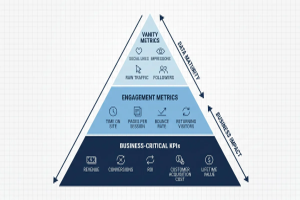
We use a four-tier framework to separate descriptive numbers from decision-ready SEO KPIs.
These provide context. They do not belong in commercial reporting.
These track operational execution — what the team did, not what the business gained.
These show whether content meets intent. Necessary but not sufficient for revenue.
These are the only metrics that belong in board-level reporting. Everything else supports diagnosis; this tier supports decisions.
Segment traffic by intent. Split organic sessions into informational, commercial investigation, and transactional groups. Marketing analytics research shows intent-segmented reporting predicts conversion rates two to four times more accurately than aggregate models.
Move beyond last-click attribution. In B2B and considered-purchase journeys, organic search often functions as an assist channel. Use your analytics platform’s data-driven model to capture assisted conversions. Reporting organic only on last-click understates its value.
Calculate organic CAC properly. Divide total SEO investment by organic-acquired customers. Compare to paid search CAC. If organic CAC rises while volume stays flat, recalibrate even if rankings look healthy.
The hierarchy assumes analytics infrastructure that segments by intent and tracks multi-touch journeys. If your site lacks event tracking or CRM integration, Tier 4 metrics may be unattainable short-term. Build Tier 3 first, then invest in infrastructure.
For B2B with six-month cycles, monthly reporting misleads. Quarterly analysis works better.
AI-driven search interfaces complicate measurement — AI overviews may satisfy queries without generating clicks. Michigan Tech research notes that visibility in AI summaries increasingly matters alongside rankings. Tier 4 metrics should evolve to include brand search demand and direct traffic growth correlated with organic exposure.
An Austrian B2B services company (anonymized) restructured SEO reporting after eighteen months of growing traffic and flat revenue. The team replaced total sessions with qualified commercial-intent sessions, added organic-assisted conversions, and tracked organic CAC versus paid search. Within two quarters, they found 60% of content spend produced informational traffic with negligible commercial value. Reallocating to bottom-funnel content cut total traffic 22% but increased qualified pipeline 41%.
Rate your reporting 1–5:
Criterion
1 (Weak)
5 (Strong)
Segment organic traffic by intent?
Aggregate only
Granular segments
Organic CAC calculated and trended?
Not tracked
Tracked vs. paid CAC
Assisted conversions visible?
Last-click only
Multi-touch modeled
Leadership sees Tier 4 default?
Vanity only
Business KPIs standard
Cadence matched to sales cycle?
Monthly for all
Aligned to cycle
Below 15: your system tracks activity, not outcomes. Above 20: reporting supports decisions.
How long until business-critical SEO metrics move? In competitive DACH markets, expect three to six months for movement in qualified organic traffic. Revenue attribution adds your sales cycle on top.
Should we stop tracking rankings? No. Rankings remain useful diagnostics for commercial-intent keywords. Remove them from executive summaries; keep them in tactical reviews.
What if our CRM does not connect to analytics? Calculate organic CAC manually by matching acquisition dates to traffic and investment data. It will be imperfect but directional. Prioritize CRM integration medium-term.
Does this apply to e-commerce? Yes. E-commerce has shorter cycles and clearer last-click attribution. The tiers remain the same; weight toward transactional metrics.
How should we report SEO in an AI search environment? Supplement traditional metrics with branded search volume and direct traffic growth. GEO optimization strategies are increasingly relevant as search fragments.
Explore premium link-building options to boost your online visibility.